
Flexibility is a property that has nowadays a high significance, and thus willingness towards flexibility is often a necessary assumption for successful developments. The term flexibility means not to attempt to break 'with the head through the wall', but in order to control resistances, having to work concertedly against them, without having to waste unnecessary strengths. Since the resistances do not always set in slowly - like in the topic of self-defense - suddenly and without prior warning, body and mind must be modified together into a flexible automatized behavior through training. Hence it is guaranteed that in an emergency we do not waste any strengths, which could also be directed towards us.
In order to be able to learn flexibility, a mental and physical strategy must pursue the relinquish of force as uppermost strategic objective. Otherwise everything must be cut down like with a lawnmower, which however assumes, that superior physical means in form of body mass, strength and range are at disposal. Since this circumstance is not equally valid for every human being (than there would not be weight classes in combat sports!), a method must be available at least for the more inferior ones, which can completely compensate the superiority of the attacker and also level the ratio of risk and security at 0%/100% - 0 % risk and 100 % of security!
As the inexperienced human being does not by nature dispose of the corresponding physical and mental tools in order to balance this ratio in an emergency situation lasting only fractions of seconds, training is necessary. This training which must evolve from the scratch in a sound and continuous fashion, it must also be carried out with a certain depth or sustainability in order to launch high-quality automatized processes also in stress situations. It is decisive that the new beginner is trained slowly, structuredly and continuously in order to give him the possibility of working himself into to the respective matter. If he is left without increase of 'dynamics' on always the same level, he then has a possibility to react to big resistances flexibly by technical variety, this possibility requires, however, also simultaneously faster data processing, which by nature cannot be fulfilled in regard to the actual demand. Everything based on the assumption, that all actions are to be executed one hundred percent correctly in order to guarantee one hundred percent security!
What has dynamics to do with this? Dynamics imply heavily an increasing or already high state of velocity and that there is no stopping of the motion process at any given point of time. These are two essential statements in regards to self-defense. Firstly: by trying to take on a higher speed, a movement produces a higher energy transfer in case of contact. Secondly: by not stopping the motion process at any point of time, the opposing strength can also not attack, since the moment of collision of two body masses is only short-term and does not give the attacking force sufficient time for its orientation of the impact direction. This in turn is important for somebody, that wants to learn to defend himself: he must not stop his motion and keep a certain speed level.
What, however, happens if dynamic movements clash? Exactly here a logical and sustainable self-defense strategy takes its basis, also in training. First, it must be understood, that the model of the continuous (dynamic) movement must be pursued - however with a logical strategy that has always validity (as a universal formula)! If this basic understanding was made, the understanding for the variety of the colliding of the most divers motion patterns must be elaborated and developed. This development begins in a certain form and finiteness and ends in a formless infinity of possibilities. It is also vital to arrange this process of development intelligently, sustainedly and safely, since otherwise the teacher becomes a nightmare for the student, who will then only feel fear the moment he steps before him.
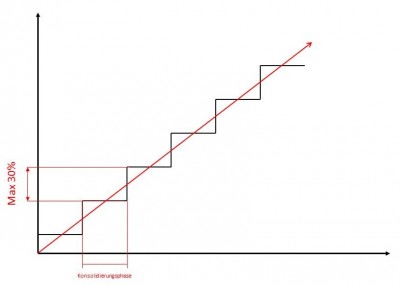
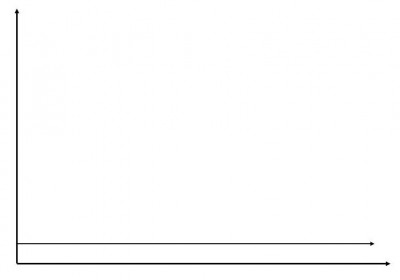
The development model of the so-called stairway- or cascade model offers the possibility for such a sustainable development: only if a new learning-stage has been consolidated through adaptation so far, a new platform lends itself. Thus a new comfort zone established itself with the student, which then has to be challenged again by the instructor through either new motion patterns and/or higher dynamics - this, however, only to challenge by excess of not more than 30 %! If this stairway model is continued and being interpolated intellectually afterwards (mathematically simply finding the common straight line), a real upwards directed development is obtained . If this model is not pursued, only a sideways movement always on the same level is obtained.
right or flat sided development
The consideration is valid always for both levels - the mental one as well as the physical one. The relation between the dynamics of the movement and the perception of the felt stress level must proceed diametrically - with increasing dynamics of motion, the felt stress level must tend more and more against zero - then a new comfort zone has been grasped. Someone who does not teach in this way, does not give the student any possibility for further development. Someone, that always demands one hundred percent without granting his student the possibility of conscious perception in order to initiate self-reflection analysis, acts equally.
But also on the student’s side a change of thinking is necessary: if the felt self-perception does not accept any dynamic working on the grounds that continuous controlled contact is not wanted ('feel of being beaten up'), then the student demands from his instructor sound teaching in regards to self-defense without any intention - tantamount without dynamics. Which attacker threatens us without the intention to hit us? Which attacker renders his or her attack undynamically (slow)?