
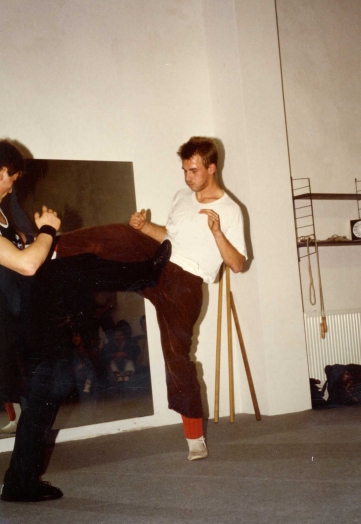
Due the medial embossment, effective/realistic self-defense is very often associated with performing kicks to the head of an upright attacker. This is a fundamental means for the movie industry to give viewers a visual traceability and to arouse emotions.
This article is not entitled to provide scientific historic accurate information, because the reasons and motivations to use kicks to the head of an upright attacker as effective means of defense can only be based on socio-cultural circumstances of tradition! But more of that later.
The cultural background should be considered first, which is very widespread in Asia, but had also a certain importance in Europe in the past: the foot is rather an offensive part of the body, which is connected to insulting or derogative attributes in interpersonal and social communication. It is, for example, not allowed to stretch the naked soles of the feet towards a Buddha statue in Thailand in temples but also towards other people or more importantly people with social rank. In Europe the contemptuous appreciation was expressed for example with a kick to the buttocks of the respective.
This article is not entitled to provide scientific historic accurate information, because the reasons and motivations to use kicks to the head of an upright attacker as effective means of defense can only be based on socio-cultural circumstances of tradition! But more of that later.
The cultural background should be considered first, which is very widespread in Asia, but had also a certain importance in Europe in the past: the foot is rather an offensive part of the body, which is connected to insulting or derogative attributes in interpersonal and social communication. It is, for example, not allowed to stretch the naked soles of the feet towards a Buddha statue in Thailand in temples but also towards other people or more importantly people with social rank. In Europe the contemptuous appreciation was expressed for example with a kick to the buttocks of the respective.
Thus, the contact of the foot with the respective part of the body of the opponent gets a certain form and mode of expression of non-verbal communication. The higher the body part in the upright position - maximum the head - the more the expression of rejection or contempt. This form of non-verbal communication of course comes from an emotional processing, or respectively brings an emotional perception to outsiders. Therefore, visually perceptible kicks are predominantly choreographed in martial arts movies, so that the viewer - who has taken on the role of good for himself - may emotionally process his contempt of the villain. The fact still is, that a kick towards a high target automatically brings along a slow speed, making it possible for the viewer to visually perceive the actions of the hero movie, so that he can emotionally live storyline (consider the maximum frame processing rate of 25 frames per second of human beings!).
If the social context of past centuries is now being considered, then it becomes obvious, that physical encounters were not only limited to winning, but also to a necessary accompanying humiliation of the attacker or enemy as an additional form of communication. So the need for visually demonstrating in a certain style is understandable – to present the ability to win and simultaneously expressing superiority, that had to generate powerlessness in others.
How is this visually best performed? By bringing the part of the body, which has the highest socially negative connotation, to the part of the body of the other, which has the highest socially positive connotation - so moving the foot to the head. And in a such a manner, which cannot be parried!
Does this line of thought work with facts of real life? This is now being examined. For this we want to briefly list the factors, which can have a disturbing influence on the movement - factors that must be controlled when trying to successfully apply a kick to the head of an upright opponent:
· Bridging the altitude floor-head level
The foot must overcome a difference in height from floor up to the height of the head, which is comparable to the launch of a rocket. It moves the foot against the earth's gravity and for the alone it needs significantly more power so that there is hardly any potential left for the energy transfer at the target point.
· Equilibrium
In order that the foot can bridge the aforementioned difference in height as described above, he must fight the gravity field of the earth, as also simultaneously the entire structure of the equilibrium must be shifted dynamically. It is to note, that the process is being terminated after the shift of equilibrium from A to B, but that at point B the foot in the air is being pulled vertically downwards by gravity. This means that this process is also very vulnerable. This is comparable to a projectile, which easily can be deviated from its trajectory by minor influences such as crosswinds.
· Possibility of change of position of the head
The head, when being threatened, always changes its position away from the attack and/or the hands or arms come up as a protective wall. Anyway, the head is not a static target, except if it has been frozen along with the trunk and the hip. Means, that the probability to hit the head successfully and with full energy in the first attempt is very low.
· External disturbance of the kick from the outside
He who is being attacked by a kick to the head, can disturb the kick at any time. The phase, in which he can interfere depends on the dynamic change in distances. Means, the foot is constantly subject to disturbance on its trajectory to the head – at which it is of no importance at which point the kick can be disturbed, but rather that it can be disturbed at all - what has a decisive effect on the dynamic change of equilibrium.
· Bridging the altitude floor-head level
The foot must overcome a difference in height from floor up to the height of the head, which is comparable to the launch of a rocket. It moves the foot against the earth's gravity and for the alone it needs significantly more power so that there is hardly any potential left for the energy transfer at the target point.
· Equilibrium
In order that the foot can bridge the aforementioned difference in height as described above, he must fight the gravity field of the earth, as also simultaneously the entire structure of the equilibrium must be shifted dynamically. It is to note, that the process is being terminated after the shift of equilibrium from A to B, but that at point B the foot in the air is being pulled vertically downwards by gravity. This means that this process is also very vulnerable. This is comparable to a projectile, which easily can be deviated from its trajectory by minor influences such as crosswinds.
· Possibility of change of position of the head
The head, when being threatened, always changes its position away from the attack and/or the hands or arms come up as a protective wall. Anyway, the head is not a static target, except if it has been frozen along with the trunk and the hip. Means, that the probability to hit the head successfully and with full energy in the first attempt is very low.
· External disturbance of the kick from the outside
He who is being attacked by a kick to the head, can disturb the kick at any time. The phase, in which he can interfere depends on the dynamic change in distances. Means, the foot is constantly subject to disturbance on its trajectory to the head – at which it is of no importance at which point the kick can be disturbed, but rather that it can be disturbed at all - what has a decisive effect on the dynamic change of equilibrium.
As shown from the four factors, the reality of kicks to the head is not based not on socio-cultural conditions, but on physical and physiological facts, which have been scientifically proven and are proven every day still. However, in opposition to that stands the human will for expression of superiority that makes the kick to the head so appealing.
How do you decide – emotionality or security?
How do you decide – emotionality or security?