
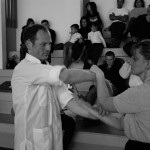
Chi-Sao (translated ‚clinging arms‘), an exercise developed from traditional fighting arts is seen from today’s neurophysiological view is the only exercise that can really program basic behaviorial changes. The sublime objective, to learn and establish control over oneself and by this over the opponent is a process that needs decades of practice if the objective is put very high.
It has already been written and reported a lot about the for and against of Chi-Saoing, but very rarely on the correlation between the influence of Chi-Sao on the general attacking behavior according to the first fighting principle of Wing Tsun: if the way is free, attack. This is the objective of this article to emphasize this subject a little more.
It has already been written and reported a lot about the for and against of Chi-Saoing, but very rarely on the correlation between the influence of Chi-Sao on the general attacking behavior according to the first fighting principle of Wing Tsun: if the way is free, attack. This is the objective of this article to emphasize this subject a little more.
It has already been written and reported a lot about the for and against of Chi-Saoing, but very rarely on the correlation between the influence of Chi-Sao on the general attacking behavior according to the first fighting principle of Wing Tsun: if the way is free, attack. This is the objective of this article to emphasize this subject a little more.
The building structure of Chi-Sao is arranged is several stages, that differ from organisation and school in terms of time and content in detail. In the IUEWT the beginning is made up of simple one armed exercises first, that make the techniques of the first form (Siu Nim Tao) much more understandable. By finishing this quite comprehensive stage, the focus will go to the double arm Chi-Sao, which will remain the essential part of the training. It is now the single arm Chi-Sao, that is used to describe the basis of Chi-Sao as such, that needs to be transitioned into the double arm Chi-Sao later.
With the single arm Chi-Sao the inactive arm is ‚parked‘ sideways to the body like the basic position in the Siu Nim Tao. After various single techniques, the so called ‚standard Dan-Chi-Sao‘ routine is introduced where the following routine is actually similar with all styles: the starting position is Tan-Sao (palm-up facing hand) and the on the Tan-Sao resting Fook-Sao (bridge arm). Partner A executes a palm attack from the Tan-Sao position and to the center point of partner B, which will be absorbed and neutralized by Partner B with a Jum-Sao. Subsequently Partner B prepares a punch attack to the center point of partner A, which will be absorbed and neutralized by A’s Bong-Sao. After this both return to the starting position..
Very often viewers to the Chi-Sao get the visual impression, that the exercise resembles a sort of a ‚two-man‘ choreography where both partners ‚present‘ themselves gifts of achievements by ‚telegraphing‘ the attacks with the body and therefore ‚presenting‘ the partner a high chance of achievement for halfway visual reactions. But this is counterproductive to the actual objective of Chi-Sao, which is the ‚tactile learning experience‘. A better approach is if e.g. the palm attack after the deflection with Jum-Sao of partner B tries to further attack, which means in practice, that partner A executes a continuous on-going pressure in order to keep his attacking threat upright. Only with a continuous on-going attacking threat, that is focused to the partner, the realization of the fighting principle of Wing Tsun will be reached: 1. way free, attack 2. stick 3. yield 4. follow
In order to better understand this principle of the on-going attack or the on-going attacking threat, a little exercise routine is shown: position yourself with a partner face to face and about 6 feet apart. Do you feel threatened in any kind by your partner now? Probably not! The distance is such that, without any ‚body telegraphing‘ no surprise momentum can be used against you.
Now your partner steps forward which normally makes about 3 feet. How do feel now? Do you still want to stay put voluntarily? Or, do you prefer to displace yourself in order to establish a ‚pleasant‘ distance again? However for the sake of the exercise you remain on the spot, so this little exercise is being intensified.
Now your partner advances even more for about 1,5 feet. How do feel now? Do you feel the necessity, that in order to not miss the last chance to re-establish a pleasant distance, it is exactly now, that you have to displace yourself? If not, you love the risky side of life. But the majority of all human beings do not like if someone intrudes into their private sector and hence reduces their security zone, which is accompanied by an execution of a threat.
Now your partner advances even more for about 1,5 feet. How do feel now? Do you feel the necessity, that in order to not miss the last chance to re-establish a pleasant distance, it is exactly now, that you have to displace yourself? If not, you love the risky side of life. But the majority of all human beings do not like if someone intrudes into their private sector and hence reduces their security zone, which is accompanied by an execution of a threat.
Right now we take it up a notch: you now displace yourself at any location and now re-establish a ‚pleasant‘ distance or security zone. At this very moment, when you execute the displacement, your partner follows and tries to keep the attained distance in its perimeter, means he does not let it get bigger again and tries to keep the same distance all the time. Now you go on with that continuously and dynamically changing routine for some time.
If we now analyze this exercise, it is recognized, that you follow continuously the expression of the ‚flight reflex‘ from neurophysiology, whereas the partner is persistently the ‚threat‘. Who of you two felt himself in a position of superiority – first of all psychologically? Rather your partner than you yourself. This phenomenon is simply explained:
while you yourself have to concentrate during the escape (most probably backwards!) on numerous things than threatening your adversary (there is a continuous on-going checking in your mind: is my rescue route free? do I keep my security perimeter stable? can I increase my distance? can I keep my balance? and so on) he only has to concentrate on primarily two things: he has to concentrate on you and on his own advancing, because everything in his vision is in front of him. Already from this fact it is much more reasonable to be a threat or better an attacker or offensive!
while you yourself have to concentrate during the escape (most probably backwards!) on numerous things than threatening your adversary (there is a continuous on-going checking in your mind: is my rescue route free? do I keep my security perimeter stable? can I increase my distance? can I keep my balance? and so on) he only has to concentrate on primarily two things: he has to concentrate on you and on his own advancing, because everything in his vision is in front of him. Already from this fact it is much more reasonable to be a threat or better an attacker or offensive!
What has all this in common with Chi-Sao? Let us return to the situation of the executed palm attack: after the palm attack has been executed and been neutralized by the partner, we came clear, that it is not clever to cease the pressure or better the ‚threatening readiness to attack‘, as the partner could use this positively for himself to bring us into a threatened position ourselves. Apart from this, a readiness to attack must be maintained at all time, because when the partner suddenly pulls his arm out of the line, we must shoot forward without any thinking and hesitation. If now the partner does not want to cease his ‚threatening readiness to attack‘ after his deflection, he also has to execute a pressure forward. If now both partners follow this principle intelligently, both persons execute pressure.
Based upon this logic the existence of a zero pressure Wing Tsun is not given, however the existence of a powerless Wing Tsun is there. Because felt power (by power of the body, muscular strength is meant) is only a subjective perception of our muscular contractions. Unfortunately, we are still not able to feel the muscular contractions of other human beings, so we can only perceive by the means of our own physical resistance. And these are to be minimized by Chi-Sao, which means to reduce any resistance! Here the taoist philosophy had a great impact on the structure of technique, because Chi-Sao teaches us to get to know the taoism in its physical form, to experience it and to change ourselves through it.

As explained at the beginning, this process of realizing Taoism in practice takes years in order to receive the merits for a change. Coming along is also a mental change attached to the maturing of a person. For example the teaching periods of Yip Man in Hong Kong were divided into several stages, where some of his original students were brought up and who differ very much in their approaches among themselves.
This can be brought back to the fact, that even Yip Man proceeded his own personal evolvements physically and mentally and that the at a time actual experiences were passed on to his students. His own process of evolvement never stopped.
This can be brought back to the fact, that even Yip Man proceeded his own personal evolvements physically and mentally and that the at a time actual experiences were passed on to his students. His own process of evolvement never stopped.